-
Pandrethan: The Temple That Water Saved
How a name that means "Old Capital" hides the story of Kashmir's first city — and the only ancient temple roof that survived
10/07/2026 By AvinashSay the name aloud, and listen to what it has become. Pandrethan. The syllables fall flat, almost dismissive, like a shrug in sound. It means, in the local tongue, nothing more than "old town" — a place whose only distinction is that it used to matter. But this name is a wound. It is a Sanskrit name that was bled dry over centuries, stripped of its music and its meaning, until all that remained was a hollow echo. The original name was Puranadhisthana — the Old Capital. And it was not merely old. It was the first.
This was Srinagari — the original Srinagar — founded by Emperor Ashoka himself in the third century before Christ. Kalhana, the great poet-historian of Kashmir, wrote in his Rajatarangini that Ashoka built here a city of ninety-six thousand dwelling houses, "resplendent with prosperity." For nearly nine centuries, this was the beating heart of Kashmir — until King Pravarasena built a new capital in the sixth century CE, and the old city was demoted to a footnote. Puranadhisthana became Pandrethan. The capital of an empire became the old town. And the world forgot that Srinagar was not always where it is now — that the real Srinagar, Ashoka's Srinagar, was here, in this quiet place where the water laps at ancient stone.
Walk there today, if you are permitted, and you will find yourself inside the Badami Bagh Cantonment — an Indian Army base that covers much of what was once the greatest city in Kashmir. The original capital, the seat of Ashoka's empire, the cradle of a civilisation, is now a restricted military zone. The irony is almost unbearable: the place that gave birth to Kashmir's identity is now a place you need permission to enter.
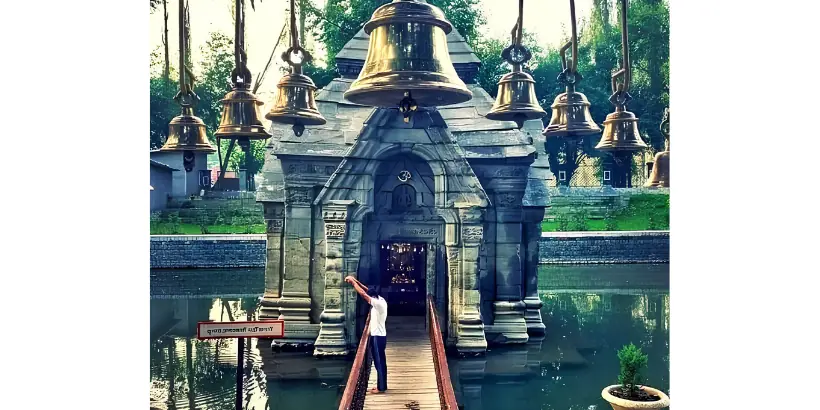
But if you are allowed through, and if you follow the water, you will find it. A small stone temple rising from the centre of a spring-fed tank, its plinth permanently submerged in two to four feet of clear, cold water. The locals call it the Paani Temple — the Water Temple. There is something almost dreamlike about the sight: a ninth-century Shiva temple, alone in its pool, as if the earth had opened a single eye to watch the centuries pass.
This water is the reason the temple still stands. While the great Martand Sun Temple was torn stone from stone by the armies of Sikandar Butshikan — "the iconoclast" — and while the magnificent Avantiswami and Sugandhesa temples were reduced to rubble, this small temple survived. It survived because it was small. It survived because it was half-hidden in water, inconvenient to reach, perhaps not worth the effort of destruction. The water that rose around its base became its armour. And in a land where virtually every major Hindu temple was demolished, the Pandrethan temple endured — modest, half-submerged, overlooked. Sometimes, in the cruel arithmetic of survival, obscurity is the only protection.
But what survives inside this water-locked sanctuary is nothing less than priceless. The Pandrethan temple houses the only original ancient temple roof still standing in all of Kashmir. The great Martand — roof gone. Avantiswami — roof gone. Every other monumental temple in the valley lost its ceiling to fire, to demolition, to time. Only Pandrethan's roof remains, and because it remains, we know what all the others once looked like. It is a single surviving witness in a valley of silenced stones.
The ceiling is constructed from nine stone blocks arranged in three overlapping squares that progressively narrow toward the centre, creating a geometric mandala of extraordinary precision. Each triangular section is carved with figures that seem alive in the half-light. At the lowest level, pairs of flying yakshas face one another, holding garlands that fall in graceful loops between them — stone frozen into movement, gravity defied by devotion. Above them, celestial figures hold discs and lotus stalks. And at the very centre — the crowning glory — a single square slab bearing an exquisitely carved, full-bloomed lotus within a beaded circle. The lotus of creation, floating in stone.
Colonel Henry Cole, surveying Kashmir for the Archaeological Survey of India in 1868, called it "one of the most perfect pieces of ancient carving that exists in Kashmir." The craftsmen were masters of a tradition that would be almost entirely erased. And yet their work was so admired that, hundreds of miles away in Udaipur, Himachal Pradesh, the builders of the Mrikula Devi temple created a wooden replica of this very ceiling. Even the Jamia Masjid in Srinagar would later echo this ceiling style in wood — though the Hindu motifs, of course, were removed. The form survived even when the faith that created it did not.
But there is a secret hidden in this ceiling — a story that embodies, more perfectly than any other, the hidden Hindu heritage of Kashmir. When Alexander Cunningham, the father of Indian archaeology, visited the temple in 1846, he discovered something extraordinary. The beautiful ceiling — and the figures carved into the walls — had been covered in plaster. Someone, at some point in the dark centuries of Kashmir's history, had taken the trouble not to destroy the temple, but to hide it. They had smothered the sacred carvings beneath a skin of plaster, rendering them invisible.
Think about what this act means. It was suppression, yes — an erasure of Hindu identity in a land where that identity was under siege. But it was also, unintentionally, an act of preservation. The plaster protected the carvings from weather, from further vandalism, from the slow erosion of time. Beneath it, the lotus and the yakshas and the images of Shiva waited in darkness for centuries, preserved like a memory held in breath. Cunningham had the plaster carefully removed, and the art beneath was revealed — nine centuries of concealment ended in an afternoon. The temple breathed again.
Years earlier, in 1822, the explorer George Trebeck had made his own pilgrimage. There was no boat available, so he swam — actually swam — across the tank, entered the waterlogged sanctum, and examined the ceiling. He found nothing remarkable. The plaster was still intact. He swam through cold water to see what he thought was a plain, whitewashed surface, never knowing that beneath it lay one of the greatest works of art in Kashmir. The temple kept its secret even from those brave enough to seek it. It would take Cunningham's trained eye, twenty-four years later, to recognise that the plainness was itself a disguise.
The ground around this temple is heavy with buried stories. In the 1920s, as British-built military barracks were being constructed nearby, workers digging foundations struck something hard in the earth. They had found not bedrock, but gods. Twenty Hindu sculptures, buried in the soil — eight of Shiva in various forms, seated and standing; five of Matrika goddesses; and one each of Ganga and Ganesha. These were not crude idols. They were masterworks dating from the second to the eighth century, centuries older than the temple itself, buried in the earth — almost certainly to save them from the iconoclastic fury that swept Kashmir in the fourteenth and fifteenth centuries.
Imagine the desperation of those who buried them — knowing that every visible trace of your faith was being targeted for obliteration, and choosing, in the last hours, not to flee with your gods but to press them into the forgiving earth. Twenty gods, interred in darkness for five hundred years. Some now rest in the Shri Pratap Singh Museum in Srinagar. Others have been lost. But their discovery tells us something urgent: beneath the soil of Kashmir, an entire civilisation lies hidden, pressing upward against the weight of forgetting.
Kalhana records that around 960 CE, during the reign of King Abhimanyu, a great fire swept through Pandrethan. The entire capital — houses, palaces, marketplaces, libraries — burned to the ground. The only structure that survived was this small Shiva temple, standing in its tank of water. The water stopped the flames, as it would later stop the hands of vandals. Twice in a thousand years, destruction came to Pandrethan in different forms, and twice the water rose up to say: Not this one. This one stays.
The doorway carries another hidden depth. Carved above the entrance is a relief of Lakulisha — the divine founder of the Pashupata Shaivism sect, one of the oldest Shaivite traditions in India. This is not merely a temple to Shiva. It is a monument to a philosophical school that shaped Hindu thought across the subcontinent. Kashmir was once the intellectual heartland of Shaivism — philosophers like Abhinavagupta, Vasugupta, and Utpaladeva developed systems of thought here that resonate through Hindu philosophy to this day. The Pandrethan temple, with its Lakulisha carving, is a physical remnant of that golden age — a time when Kashmir was a centre of spiritual learning, when scholars came from across India to study in its academies and meditate in its temples.
Today, a small park surrounds the temple, built in 2021, where some excavated artefacts are displayed. Restoration work has been done. The temple is, formally at least, protected. But it remains inside a military cantonment, inaccessible to most pilgrims, unknown to most Kashmiris, invisible to the world. Ashoka's city of ninety-six thousand houses is a footnote in guidebooks, a name that children no longer learn in schools.
This is what erasure looks like. It does not always come with bulldozers and dynamite. Sometimes it comes with renaming — Puranadhisthana becoming Pandrethan, the first city becoming the old town. Sometimes it comes with plaster, with burial, with the slow forgetting that turns a living heritage into an archaeological curiosity. Sometimes it comes with restricted access and security clearances, with the best of intentions but the same result: the people who should be praying here cannot reach it. The people who should be learning from it do not know it exists.
And yet. The temple stands. The water still rises around its base, as it has for eleven hundred years. The lotus still blooms in stone on a ceiling that has survived fire, conquest, and neglect. The buried gods were found, however imperfectly, and some of them were saved. The plaster was removed, and the art beneath was revealed. Against all the forces of erasure — the renaming, the iconoclasm, the forgetting — this small temple has endured. Not because it was the greatest, not because it was the most powerful, but because the water embraced it, because someone chose concealment over destruction, because a British archaeologist cared enough to remove the plaster, because a worker digging foundations in the 1920s recognised that what he had found was sacred.
This is the story of Hindu heritage in Kashmir. Not a story of triumph, but a story of survival against impossible odds. Not a story of preservation, but a story of rediscovery — again and again, century after century, finding what was hidden and calling it by its true name. The Pandrethan temple does not ask for pity. It asks only to be remembered. To be visited. To be spoken of as what it truly is: not a "water temple" in an old town, but a Shiva temple in the first capital of Kashmir, built by masters whose names we will never know, sheltering the only original ceiling in a valley of lost roofs, holding in its stone the memory of a civilisation that once made this place the intellectual and spiritual centre of India.
Puranadhisthana. The Old Capital. Say the original name. Let it live again.